What Defines Me?

LifeLink Devotional

March 15, 2016

Psalm 77:10  Then I said, “I will appeal to this, to the years of the right hand of the Most High.”

(Before I begin, a reminder of what I am currently trying to accomplish in these devotionals. I am working my way through the Psalms one-by-one, and picking out one highlight that the Holy Spirit uses to continue the process of producing the character of Christ in me. We are just past the half-way point.)

Birthdays carry the potential of discouragement. They also carry the possibility of celebration. It is quite probable that both are experienced. The outward celebration could be only a mask for the inner realities of fear, doubt, and depression. Aging can be scary. Getting old brings the doubt of worth based on the reality of reduced function. And what makes it even worse is when the memories of the productive years are gone. It is such a shame that we spend so much of our lives convinced that our value is based upon our abilities. Then we reach an age where we lose both the abilities and the memories of what we did. The result is we have nothing upon which to base our personal worth.

Now in case you are concerned, that is not what my birthday did to me yesterday. The assumption might be that I live in a state of denial about my age, and I will do everything possible to prove my abilities. That is also not true. Well, at least partly not true. I still think I can do many things that I did when I was younger, so that could be considered denial. However, I do not gain or lose personal value based on my ability or inability to continue to do those things. My performance does not dictate my worth!

In the 77th Psalm, written by Asaph, there is a verse that in the last week has become very significant in my life. It comes after Asaph has confessed that he is trying to restore the good old days. He is trying to remember how it used to be, and it’s messing up his mind. He gets so discouraged that he even blames God for not caring anymore and for withholding His love.

Have you ever really thought about what causes us to get discouraged when things can’t be the way they used to be? I have, and I have reached the conclusion that it boils down to one simple thing – I still consider the best times of my life to be the times when I was in control and things worked out for my benefit. You too, right?

When things go bad today, our default is to remember the times when things were great. We then assign ourselves the credit for them being great. This in turn reinforces our desire to take control again because we believe that since we made things great once before we can do it again.

But look at what Asaph concluded. After trying to remember the days of old (verse 5) he reaches this conclusion in verse 7 – Then I said, “I will appeal to this, to the years of the right hand of the Most High.”

Every one of us must come to the point when we realize that the best times of our life were not defined by the good or bad circumstances we enjoyed or endured, but rather they were defined by the reality of God working in and through every one of those circumstances to produce the character of Christ in us.

Listen, there is no possible hope for the present in trying to remember what we did in the past. But, as Asaph says, I will remember the deeds of the Lord; yes, I will remember YOUR wonders of old. (Verse 11 – emphasis mine)

Asaph also declares that the key to understanding the past and the present is this – Your way, O God, is holy. (Verse 13) You see, through the good and the bad of the past and the present, God is at work according to His holy nature to produce the character of Christ in us. What that means is this: the circumstances of life do not define God any more than they define me. Instead, and this is a powerful truth that will transform our lives –

God designs the circumstances of life to reveal His definition of me.

So when things get tough – even unbearable – remember this: we can appeal to the years of the right hand of the Most High. His right hand upholds us, sustains us, shapes us, carries us, nurtures us, and provides for us.

But maybe most of all, His right hand assures us that we are His – not defined by life, but declared possessors of eternal life. It has to be true, for God could not hold in His hand anything that does not measure up to His holiness – a holiness we have in Christ Jesus His Son.

Pastor John

Evaluating Significance

LifeLink Devotional

Tuesday, March 8, 2016

Psalm 76:11 Make your vows to the LORD your God and perform them;

Question: What is the most significant contribution you make to your family, your place of work, or your church?  Take some time to really think about this. I will wait…

(insert imaginary jeopardy music here)

Now, let me ask you another question? How many of the options you considered as an answer to the first questions were in the category of actions, functions, or accomplishments? And if so, why? Why is it that we consider our most significant contributions to life to be the things we do?

We are so stuck in a performance-based value system. We tend to measure our significance by what we do, which opens up can after can of worms; worms that eat away at the reality of our worth rather than truly express our worth. We put our faith in the worms to define our value, which only leads to us feeling like dirt.

There is the worm of expectations. We become motivated by what we believe others expect from us, and if we don’t measure up then we minimize our significance.

There is the worm of excellence. We are driven by the need to do things so well that no fault can be found in how we performed. Performance becomes the standard by which our worth is measured.

May I suggest, at the risk of it sounding arrogant, that the most significant contribution you make to any social or spiritual relationship to just be you?

YOU!

You are significant. Not because of what you have done, but because of what God has done and is doing in you. You do not earn significance. Significance is a gift of grace that declares your eternal worth in Jesus Christ.

Significance does not need to develop. The first declaration of significance God makes over your life when you receive Jesus Christ as your Lord and Savior is the final declaration you will ever need.

Significance does not fade with unfulfilled expectations or lack of excellence, for that would mean that God’s love is capable of fading.

From the moment this truth is realized and believed, expectations and excellence cease to be the means by which we gain significance and they become the means by which we express significance.

Because we are significant, we can consider others better than ourselves (Phil. 2:3) and love them by seeking to fulfill their expectations.

When we understand our significance, we will do all things with excellence as an expression of the worth of Jesus Christ in us. (1 Peter 2:9)

When we truly accept that the glory and excellence of Jesus Christ has been granted to us by God the Father (2 Peter 1:3), then we will cease from making promises to people and seeking to fulfill them to earn our worth. Instead, we will make our vows to the LORD your God and perform them as an expression of His great worth in us.

You are the most significant contribution to any social or spiritual relationship you have. Not because of what you do, but because you bring Christ to that place.

Motivated to Give Thanks

LifeLink Devotional

Thursday, March 03, 2016

Psalm 75:1  We give thanks to you, O God; we give thanks, for your name is near.

I find that one of the hardest commands of Scripture to obey is this – “give thanks in all circumstances.” (1 Thessalonians 5:18)

Many times it seems unreasonable to be thankful. Tragedy doesn’t stimulate thanksgiving. News that rocks our confidence in the future does not generate gratitude. Circumstances that disappoint our expectations do not arouse an attitude of appreciation. How are we supposed to be thankful when the things happening to us really stink?

We have the answer to the issue of thankfulness in Psalm 75. Thanksgiving is not motivated by circumstances; it is motivated by the nearness of God.

The simple truths of thankfulness are these:

  • God never changes
  • God is always faithful
  • God has a plan
  • The closer I am to God the more I trust Him
  • The more I trust Him the more thankful I am in all circumstances

Very quickly, Asaph, the author of this Psalm, teaches us that giving thanks depends on understanding the following things:

  • God is near – vs. 1
  • We remember the great things God has done in the past – vs. 1
  • We remember the declaration of God that He will bring a just end to all things – vs. 2
  • We remember the guarantee of God that He is in absolute control of all things – vs. 3

There is one huge lesson I learned from this Psalm. It is in verses 6 and 7.

For not from the east or from the west and not from the wilderness comes lifting up, but it is God who executes judgment, putting down one and lifting up another.

Our natural tendency is to look around us for the solutions to the circumstances that grieve us. We desire to be lifted up from the pain and fear generated by our circumstances. So we begin a search for a new doctor, a new diet, a new direction, or a new deliverer. We believe that the only way to be able to give thanks is for us to resolve the problem.

But Asaph tells us the truth that we will not be lifted out of the quicksand of our circumstances by any human hand or human wisdom. We are guaranteed, however, that God will lift us up in His appointed time. In that truth lies the motivation for giving thanks. Deliverance is coming. God will accomplish it in His time. His name is near. He has done it before, and He has assured me that He is working with the same power and authority in this case as well.

We give thanks to you O God. Not for what is around us, but for the fact that you are in us and your love never fails!

Pastor John


Implicit Trust

LifeLink Devotions

Tuesday, March 1, 2016

Psalms 74:12 But you, O God, are my king from of old; you bring salvation upon the earth.

There’s a special relationship between the flyer and the catcher during a circus trapeze act. In case it’s not obvious, the flyer is the one that lets go, and the catcher is the one that catches. As the flyer swings high above the crowd on the trapeze, the moment comes when he must let go. He arcs out into the air. His job is to remain as still as possible and wait for the strong hands of the catcher to pluck him from the air. The flyer must never try to catch the catcher. The flyer must wait in absolute trust. The catcher will catch him, but he must wait.

I remember playing with my boys when they were little, throwing them in the air and catching them just before they hit the ground. They would giggle with delight and say, “Again! Do it again!” They were totally relaxed and trusted me to catch them. As I would do this, my thoughts were, “If I were the one being thrown in the air, I‘d be stiff as a board. I wonder why my son is so relaxed and trusting?”

Then it dawned on me – we had a history together. We had done this before, and I had never failed to catch him.

Trust is earned. We live within that template. Any confidence we place in a person or thing is based on previous experience. Blind trust is difficult at least and impossible for most. God created us that way, and he has created a history with us so that we can trust Him.

Psalm 74 is the historical template of Israel’s trust. While the enemies of God march against the nation and have defiled and decimated the temple, the Psalmist reminds the people of their history with God. Look at the symbolism of verses 13-17.

  • It was you who split open the sea by your power… Here is a reference to the parting of the Red Sea as Israel escaped from Egypt.
  • You broke the heads of the monster in the waters. The monster is the Egyptian army, and they were destroyed in the Red Sea.
  • It was you who crushed the heads of Leviathan and gave him as food to the creatures of the desert. As the bodies of the dead Egyptians washed up on shore they became food for the creatures of the land.
  • It was you who opened up springs and streams; God provided water from a rock for the people as they traveled through the wilderness. You dried up the ever flowing rivers. The Jordan River was dried up so they could enter the Promised Land. The day is yours, and yours also the night; God led them with a pillar of smoke by day and fire by night.
  • It was you who set all the boundaries of the earth; God gave them their inheritance in the Promised Land even though it was already occupied by others.
  • You made both summer and winter. They had never lived anywhere except where it was summer all the time. Now they were occupying and dwelling in a land that had summer and winter. It was their new and permanent home.

When times got tough in their new land, their trust wavered. They felt like they had been dropped. They stiffened up and wanted the game to be over. They needed a reminder from history that God would not fail them.

We need the same reminders. When we read God’s Word we discover God’s template of trust. His nature and character are revealed, and because He is unchanging and constant, what He did for others He will do for us as well. His methods may change from generation to generation and from person to person, but His faithfulness can never change. 2 Timothy 2:13 says, if we are faithless, he will remain faithful, for he cannot disown himself.

In addition to the Biblical record of God’s trustworthiness, you have a personal history with God as well. He has worked on you and in you since you received His Son Jesus as your Savior. He has done great things in your life, and has filled you with the hope of glory that surpasses any and all trials and troubles of this life.

Take some time today to recall God’s awesome works in your life. It is your template of trust.

Remember it.

Review it.

Reflect on it.

Repeat it to your family and friends.

Then, no matter what your circumstances, you will be able to say – But you, O God, are my king from of old; you bring salvation upon the earth.

Pastor John

No Comparison

LifeLink Devotions

Monday, February 29, 2016

Psalm 73:23-28  Nevertheless, I am continually with you; you hold my right hand. You guide me with your counsel, and afterward you will receive me to glory. Whom have I in heaven but you? And there is nothing on earth that I desire besides you. My flesh and my heart may fail, but God is the strength of my heart and my portion forever. For behold, those who are far from you shall perish; you put an end to everyone who is unfaithful to you. But for me it is good to be near God; I have made the Lord GOD my refuge, that I may tell of all your works.

I have found in all of these years of following Jesus that the Word of God clearly and precisely touches the reality of who I am. Sometimes it really hurts to recognize that the Holy Spirit is using the divine revelation of God in the Bible to address the most personal of issues that affect my life.

So it is with Psalm 73. I have one of those love/hate relationships with it. I love the way it ends. I don’t like the way it convicts me in the beginning. You see, this Psalm describes me.

I tend to make comparisons. And like Asaph, the author of this Psalm, those comparisons are distorted. I think we can all relate to this. We tend to see what we want to see because our hearts are already convinced that there is something better that we are missing. When our minds have determined that we are not experiencing everything we could, then we tend to be extra-observant of those things we think we are missing.

For example, when you wanted to buy a different car, and you had to choose a model and a color, you started noticing how many other cars just like it there were on the road, didn’t you? There were no more of those cars on the road today then yesterday, but suddenly you noticed more of them because it’s what you wanted.

Asaph is not happy about his financial condition and social status. He thinks he would be better off if he had more money. Suddenly it looks like everyone who doesn’t trust God has what he wants. His impressions of the ungodly person become so distorted that in addition to being wealthy he thinks they also have no struggles. Their bodies are healthy and strong. They are free from the burdens common to man. They appear to not be plagued by human ills. All he can see in the unsaved person is what appears to be great prosperity in every part of their lives.

This is a huge distortion of reality, isn’t it? But when we play the comparison game we invite the Enemy to deceive us into thinking that we are missing something and only the world can provide it. We are tempted to pursue their independent and self-sufficient lifestyle, being carefree and increasing in wealth.

But Asaph quickly comes to his senses. He passes on the opportunities of the immediate and with a mature perspective he considers the long-term ramifications of his choices. The immediate benefits of worldly living are not worth the ultimate destruction that will come upon all who choose them.

Satan has devised an attractive “70 years same as cash” offer. He has sold people a bill of goods. His advertisements are convincing. People believe that personal happiness is the ultimate experience of life, and that the world’s ways are the best ways to achieve that happiness. And you don’t have to pay a thing now to enjoy all of the benefits. Just sign this contract and take the merchandise home today. You can pay for it in 70 years.

Asaph doesn’t fall for it. He’s tempted, but when he takes the offer to God (verse 17) his eyes are opened to be able to read the fine print. He sees that in exchange for immediate pleasure and prosperity we sacrifice eternal life. Payment in full is required upon your death. Payment consists of the total loss of life, wealth, health, relationships, and freedom and an eternity of suffering separated from God in the lake of burning sulfur.

If only more people would pay attention to the fine print. Asaph does and chooses wisely. He says, “Earth has nothing I desire besides you. My flesh and my heart may fail, but God is the strength of my heart and my portion forever.” (verse 25)

The choice seems easy. It’s either the world now and nothing later, or God now and everything later. Those who choose the world now may get the world’s goods now, but they get God never. Those who choose God now may have to suffer for a while, but God is there to walk through it with them, and God will bring them into His glory when it’s over.

Don’t let Satan convince you that you’re missing something. Eve fell for that in the garden and look where we are today. Don’t fall for his comparison game with the world. You’ll end up with nothing. Delete from your memory bank and thought process any phrases that start with, “It would be good if I had ____________.”

Instead, live by this statement – “It is good to be near God.” (verse 28)

Pastor John

The Historical Christ

LifeLink Devotional

Tuesday, February 23, 2016

Psalm 72:18-19  Blessed be the LORD, the God of Israel, who alone does wondrous things. Blessed be his glorious name forever; may the whole earth be filled with his glory! Amen and Amen!

As King David neared the end of his life he decided to write a prayer for his son Solomon who would succeed him on the throne of Israel. We have that prayer recorded in the Seventy-Second Psalm. As he prays for his son to be a man of justice and righteousness, he recognizes that the distinguishing characteristic of a great leader is compassion. Three separate times in this prayer David refers to the recognition of the needy, the defense of the poor, and the deliverance of the oppressed.

Then something happens. King David is transported in his spirit from his prayer for his son to a recognition of God’s son as the true King. Suddenly, in words that cannot apply to the historical reign of Solomon, David speaks prophetically about the coming King of Kings. It is at the conclusion of those prophetic words that David writes – Blessed be the LORD, the God of Israel, who alone does wondrous things. Blessed be his glorious name forever; may the whole earth be filled with his glory! Amen and Amen!

Recently I had an experience that was similar, although not nearly at the same level of Divine revelation. Last Tuesday my wife and I stood in the midst of the ancient Mayan city of Tulum on the shores of the Caribbean Sea. I was thrilled. I love places like this and could spend hours exploring them.

As we listened to our tour guide, and expert in Mayan history, he began to inform us about the various gods of the Mayans that were depicted in the carvings on their temples. He talked about only a few of the 136 gods that they worshipped, like the rain god and the sun god and the bee god. Then he pointed to a carving on the corner of one of the temples. It was carved in such a way that when seen from the side it formed a profile of the god, and when seen from the front it formed a full face. Hopefully you can see that in the images below.

20160216_100014 20160216_100132As the guide explained to us that this god was carved into all four corners of this temple, he stated that this was the creator god, the supreme god over all the other gods.

Up to this point my mind was totally concentrating only on the earthly historical aspects of the Mayan people.

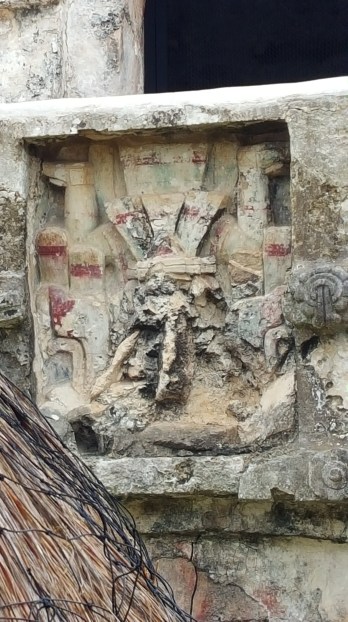
But then the guide pointed to another carving of a god. He is called the descending god, and is carved with his head downward and his legs upward. In the first picture you can see the head and a leg, and in the second you can see the legs more clearly. He is seated upside down on a throne, and is always at the top of the temple.

20160216_102908 20160216_100155

Immediately my mind was transported from the historical civilization to the historical Christ.  Did this ancient civilization have an understanding of God that included God himself coming to earth? I began to study the gods of the Mayan culture, and there is, according to one source, no evidence that the descending god represents Christ. And yet, even in all the false religions of the world, there is an understanding that God is somehow involved personally in the affairs of man.

For the rest of the tour I could not stop praising God that I know the truth that He did descend from glory in the person of Jesus Christ to save the world from its sin. I praise God that there are no other gods, and that He alone is the Creator of all things. I praise God that His glory fills the earth to such a degree that even in the false religions of the world He can be seen. I praise God that Jesus Christ sits on the throne of heaven and rules all things, and he does so with a heart of compassion, love, righteousness, and justice.

What started out as simply an historical adventure turned into a deeply significant spiritual moment for me.

Blessed be the Lord!

Pastor John

I’m Old…and Better Than Ever

LifeLink Devotional

Monday, February 22, 2016

Psalm 71:18  So even to old age and gray hairs, O God, do not forsake me, until I proclaim your might to another generation, your power to all those to come.

I was set up. The surprise birthday party for a grandson on Saturday turned into an amazing surprise as my daughter and her family from Sun Prairie had driven up to turn the party into a family celebration of our 40th wedding anniversary. We sat around the pool at their hotel and watched the 10 grandchildren frolic in the foam of the hot tub and splash their way from one end of the pool to the other. We had pizza and cake and presents.

When we went to bed that night my wife and I were overwhelmed with the blessings of family.

We rested well. What we had just received from our kids was sufficient.

We were set up.

When the worship service started on Sunday morning it was revealed – totally to our surprise – that there would be a 40th wedding anniversary reception after church as a part of our regularly scheduled CRAVE meal. The worship center was transformed almost instantaneously after the service into a banquet hall. The grandkids moaned and giggled as Grandma and Grandpa responded to the clinking of glasses with kissing. As we ate, Denise and I were honored by our children with a video that commemorated our lives and our love.

I cried.

Included in the video were interviews with the grandchildren. The answers they gave to multiple questions asked about Denise and me revealed the depth of our family love. You see, only in a relationship of trust based on love can grandchildren confess that the most significant result of Grandpa’s forty years of marriage is that he is old and bald.

For the past several weeks I have been studying the words of King David in the 71st Psalm. They have been the soul nourishment that I have needed. While my body needed the break it received while we were on our anniversary trip to the Cancun area, my heart needed the daily washing of Psalm 71. I wish I had the time to tell you everything that God spoke to me through His word, but I will share this one point –

Even though I am old and what hair I have left is gray, my God has not forsaken me, nor will he, so that I may proclaim to the next generation the might and the power of God.

But I will hope continually and will praise you yet more and more. My mouth will tell of your righteous acts, of your deeds of salvation all the day, for their number is past my knowledge. With the mighty deeds of the Lord GOD I will come; I will remind them of your righteousness, yours alone. O God, from my youth you have taught me, and I still proclaim your wondrous deeds. So even to old age and gray hairs, O God, do not forsake me, until I proclaim your might to another generation, your power to all those to come. (Psalm 71:14-18)

I am so glad that a child’s definition of old does not affect God’s power for service.

My lips will shout for joy, when I sing praises to you; my soul also, which you have redeemed. And my tongue will talk of your righteous help all the day long… (Psalm 71:23-24)

It’s Both/And, Not Either/Or

LifeLink Devotional

Thursday, January 28, 2016

Psalm 70:4-5  May all who seek you rejoice and be glad in you! May those who love your salvation say evermore, “God is great!” But I am poor and needy; hasten to me, O God! You are my help and my deliverer; O LORD, do not delay!

The Bible is filled with either/or statements. For example, Jesus said, “You cannot serve two masters. Either you will love the one and hate the other, or you will hate the one and love the other.”

Either/or statements are powerful choice-making motivators. We latch on to them because they tend to give us a sense of pride that we are in the right. However, they also alienate us from others who haven’t reached the same conclusion or made the same decision. And we certainly lack understanding of the people who are stuck in the twilight zone known as indecision.

That’s why I am so thankful that the Bible also includes both/and statements. Today’s Psalm is one of them. Let me explain.

There are five verses in this prayer of David. It was a prayer he had turned into a song to be sung in worship by people who were feeling the stress and trials of life’s circumstances. That’s why it is called a memorial song – it is a song that reminds us of who God is when life tends to make us forget.

Of the five verses in this Psalm, the first three relate the trouble King David is experiencing and his suggestions for possible solutions.

  • He feels that God is not working fast enough to resolve his issues (vs. 1).
  • He shares somewhat boldly and bitterly that he wants God to cause problems for the people that are bothering him (vs. 2).
  • He asks God to have the people that are making fun of him to stop their activities and to feel the shame of what they have done (vs. 3).

Then, in a moment of spiritual enlightenment in the midst of the darkness of his trouble, David says this – May all who seek you rejoice and be glad in you! May those who love your salvation say evermore, “God is great!”(vs. 4).  David recognizes that his circumstances have not changed the very nature and character of God. God is still great even when life isn’t.

Immediately David returns to the sorrow of the day and confesses to God that he is poor and needy, and that God should hurry up and fix this (vs. 5)

Here’s my point – Having trouble and praising God is not an either/or proposition – it is a both/and reality. It’s totally fine with God to be both upset with life’s circumstances and at the same time recognize and rejoice in His greatness and His salvation.

Bottom line, it is possible to be mad and glad at the same time. It think if we would accept that, and understand that God has declared a both/and truth rather than an either/or truth, we might find a little more patience and perseverance in the midst of the problems because we have learned how to praise him in the storm.

Pastor John

Take Your Hands Off!

LifeLink Devotional

Monday, January 25, 2016

Psalm 69:13  But as for me, my prayer is to you, O LORD. At an acceptable time, O God, in the abundance of your steadfast love answer me in your saving faithfulness.

For three weeks I have been camped in this scenic overlook meditating on this verse. When I wake up in the morning and open the blinds of the camper to see the new day, a truth as new as the colors of the sunrise fills my vision. When I stare out into the vast universe before I close the blinds to sleep I am embraced by the magnificence of God. I see myself as one of those tiny twinkling lights and yet somehow I know that God sees me, knows me, named me, and loves me. In between my rising and my resting, I am overwhelmed with the abiding presence of God knowing that whatever happens, He has an acceptable time for it to be resolved.

Not until today have I been led to write about what God has shown me from this verse. I am going to be brief and simple. But let me say up front that I challenge you to find a way to camp in this same scenic overlook for some time and reflect on the marvel of God’s love and faithfulness.

First, the history. David is in trouble. He shouts, “Save me, O God!” The whole Psalm is a summary of David’s current trouble – serious trouble – and His cry to God for deliverance. Can you relate?

Now the lessons God is teaching me from verse 13:

  1. Take your hands off it. People may be talking about us, spreading gossip and lies, or seeking to harm us with words or actions. Our natural response is to strike back with enough force to stop the attacks. At the minimum we seek to set the record straight. Take your hands off it. But as for me, my prayer is to you, O LORD.
  2. Wait for God to act in His time. Notice two things – God has a time to act, and God’s time is the only acceptable time. Anything and everything I do any other time is unacceptable and will not resolve the problem.
  3. God will answer in the abundance of His steadfast love. Go ahead, break this down word by word. God will answer. The answer will be a direct expression of His love. He will answer because His love is steadfast and never stops motivating His activity. His love is abundant, so His answer are not limited to just solving the problem but also bring growth and maturity to us.
  4. His answers always save us. The problem will be resolved – in His acceptable time. Our lives will be changed because of His abundant love.
  5. He is faithful to save us. He cannot not rescue us. He is mighty to save, and His faithfulness guarantees our deliverance.

The perceived deadly or destructive influence of your present situation is easily handled by God. Trust Him. Let Him work in His time. He is loving and faithful. He will deliver you.

Take your hands off!

Pastor John

Get On The Train

LifeLink Devotional

Thursday, December 17, 2015

Psalm 68:18   You ascended on high, leading a host of captives in your train and receiving gifts among men…

It is fitting as we approach Christmas Day next week that the final installment of my study of Psalm 68 brings us to verse eighteen. Fitting because David’s words are given by the Holy Spirit to the Apostle Paul in Ephesians chapter four as the basis of his teaching that Jesus Christ, God Himself, came down to earth to accomplish God’s redemptive purpose.

In Psalm sixty-eight, King David is reflecting on the awesome power of God to deliver the oppressed and save them. In fact, more than half of the thirty-five verses refer specifically to the power and might of God to save people from captivity and to conquer His enemies.

Bear with me as we look at a little history to gather some context for today’s truth. It may seem boring, but it is highly relevant. The lesson comes from verses 15 and 16, where there is an interesting metaphor used by David. It is one of those passages that on the surface probably makes very little sense, but with the Holy Spirit’s illumination it becomes very clear.

O mountain of God, mountain of Bashan; O many-peaked mountain, mountain of Bashan!  Why do you look with hatred, O many-peaked mountain, at the mount that God desired for his abode, yes, where the LORD will dwell forever?

In The northernmost part of Palestine was the region of Bashan. A series of volcanic mountains lined the region, while its valleys were some of the most productive agriculture land in all of Israel. It was the territory given to the tribe Manasseh when the Promised Land was divided up.

You remember the story of Manasseh, right? He was the first-born son of Joseph, yet in spite of Joseph’s attempt to correct an error, Jacob gave the second-born son Ephraim the blessing as one of his own sons. Jacob declared that the younger son will be greater than the older and will play a more prominent role in God’s redemptive plan. In addition, he gave them a mountain slope that he captured from the Amorites – the mountains of Bashan. Later, the tribe of Manasseh would occupy that territory, and even though it was highly fertile and productive, there was a constant jealousy of other tribes who seemed to get more than they did.

Now, jump ahead a few centuries. The Kingdom of Israel has been established, and Mount Zion chosen as the place where the King would reign forever. Instead of rejoicing, the mountains of Bashan express envy that they were not chosen. The entanglement of envy still held them captive.

Envy still holds us captive as well. We are bound up in the chains of comparison. Want proof? Watch what happens when you open Christmas presents this year. The verbal and non-verbal communications will be clear. Why do they have more than me? Why did he get a bigger present than me?  I wanted that!

King David offers us the solution – not just to envy, but to the whole big picture of God’s redemptive plan. You ascended on high, leading a host of captives in your train and receiving gifts among men…

Paul restates the case with added information in Ephesians 4. But to each one of us grace has been given as Christ apportioned it.  This is why it says: “When he ascended on high, he led captives in his train and gave gifts to men.”  (What does “he ascended” mean except that he also descended to the lower, earthly regions?  He who descended is the very one who ascended higher than all the heavens, in order to fill the whole universe.)

Jesus Christ, God Himself, descended from His position and glory in heaven to set free all the captives of sin and give them gifts to be used to serve God in His redemptive plan. We have been raised with Christ and have been seated with Him in the heavenly places. Regardless of social status, inherited injustice, or current captivity, Jesus Christ has paid the purchase price for your freedom. FREEDOM!

That is God’s redemptive plan – the blood of Jesus Christ and the power of His resurrection can and will set you free if you choose to believe. That’s why Jesus descended to the earth and was born of a virgin – to die for our sin. That’s why He was qualified to ascend to the throne as King of Kings and Lord of Lords.

Now, the eternal question – are you in His train?