There is a word that has been freely running around in my brain for the last week or so when I read these verses in Psalm 51. “Wash me thoroughly from my iniquity, and cleanse me from my sin! Purge me with hyssop, and I shall be clean; wash me, and I shall be whiter than snow.”
I have used the word that came to me in prayer because it gives me a word picture that I need. I am certain that when you first read this word you will react in some way. The word may capture your mind as it has mine, or you may reject it because you may think it is in bad taste. It all depends on what you think it means and what it reminds you of.
The word has multiple meanings. It can mean “a sudden rush of intense emotion.” It can also mean “a reddening of the face or skin.” The word is used to describe things that have become even or square with one another. In slalom skiing it is “a consecutive series of vertical gates.” In the medical field it is used to describe procedures intended to cleanse wounds and clean debris. In the military and in hunting it is used to describe an action that chases the enemy or the wild game out of hiding. The word is used in card games to describe a certain winning hand. And in the bathroom, it is the action of using water to eliminate waste and replace it with clean water.
FLUSH.
Lord Jesus, I surrender my will to yours so that it is flush with your purpose.
Lord Jesus, grant to me in moments of quietness and prayer a flush of your presence.
Lord Jesus, cleanse the wounds of my heart with the Living Water so that there is no debris hindering the fullness of the Holy Spirit in me.
Lord Jesus, flush the enemies of righteousness from hiding in my life that they may be exposed and taken captive by truth.
Lord Jesus, flush from my mind all thoughts that you declare to be waste.
Lord Jesus, may every step I take pass only through the flush you have prepared for me to direct me on the slopes of life.
He tried it all. He spent his entire lifetime pursuing everything that life has to offer in an attempt to discover the purpose for human existence. Years were spent building a name for himself and acquiring everything one man could ever want or need. He was wealthy beyond imagination and wise beyond belief. He indulged himself in every known pleasure and passion. Yet in the end, Solomon concluded this inEcclesiastes 12:13.
“The end of the matter; all has been heard. Fear God and keep his commandments, for this is the whole duty of man.”
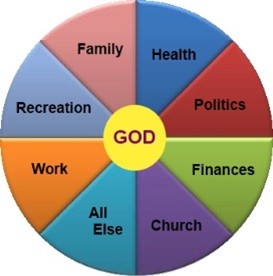
As I contemplated that verse and its application to the priorities of my life, I discovered an important truth. My life is not to be a pie chart with every part of my life in equal balance. It is not to have one slice labeled “spirituality.”
Nor is it to be a pie chart with God at the center under the assumption that suddenly all the other areas of my life will be brought into order while still giving me the right to wander in all of those areas as I see fit, somehow claiming that God now has blessed my wanderings.
We have been deceived into believing that our lives will be better and more balanced by adding God to them. Nothing could be further from the truth of the Gospel. God never asked to be added to our lives. He has provided for our crucifixion with His Son Jesus, so that our life is cast aside, and the life of Jesus Christ is born in us. We do not add God to what we have determined is the path of our lives, but rather we raise a white flag of surrender and place our lives fully into God through Jesus Christ. We are added to Him, not the other way around.
F.B. Meyer wrote this in his devotional for today – “It is only as we refuse to be conformed to this world, and yield ourselves to be transformed by the free entrance of the Holy Spirit into our minds, that we can learn all that God will do for us. We are nothing; He is all. And He is prepared to be and do all things in us, if only we will open to Him as the land lies open to the summer sun.”
When we begin to understand that we are to be found in Christ and that Christ is our life, then we will know what it is to love God and then love others as Christ did. The purpose of man is to discover the purpose of God for man, and Jesus stated it clearly when He said, Love the Lord your God with all your heart, your soul, your mind, and your strength; and love your neighbor as yourself.
I can’t do that with God as just a part of my life. I can only do that when my life is lost in His.
I came across this story as I was reading this morning. In 1997 Warner Brothers released a movie entitled Addicted to Love. There’s a scene in this movie that illustrates the priority of love.
The movie tells the story of a small-town astronomer by the name of Sam whose love for his girlfriend Linda is deeply tested. Sam’s romantic love for Linda is illustrated early in the movie as we find him at work at the observatory.
He has his telescope trained on a star that is becoming a super nova. The amazing discovery is an obvious source of excitement for a visiting scientist. As the clock approaches high noon, one of Sam’s colleagues calls his attention to the time. Without explanation Sam turns the telescope away from the heavens and aims it at a school playground. The visiting scientist can’t believe that anything else on earth could be so important as to suspend the once-in-a-lifetime look at a super nova being born. Carl, one of Sam’s associates, tries to explain.
“Professor, there’s this other phenomenon that Sam gives his priority to every morning,” Carl says.
The guest scientist asks, “What could be more important?”
Sam, without skipping a beat, aims the telescope at a school playground several miles away. Through the telescope he sees Linda. In the midst of her responsibilities as a schoolteacher, she glances at her watch and then proceeds to look in the direction of the observatory. In what has become a practiced ritual, Linda smiles and waves.
Men, there’s nothing – I MEAN NOTHING – more important every day than to make sure your wife knows that she is the priority of your life. When you turn the telescope of your heart from its consistent focus on the heart of God it should not seek to gaze upon anything in life before it captures a view of your wife. Do not begin the tasks of the day until you have taken her in your arms. Do not look at your career until she knows you care for her success more than your own. Never put wealth ahead of her well-being. Surrender your will to her wishes.
Ephesians 5:25 “Husbands, love your wives, as Christ loved the church and gave himself up for her.”
Maybe the telescope of your life needs to be re-trained so it is primarily focused on your wife. She is God’s gift to you, and no matter what your pride wants you to believe, you don’t deserve her. Make sure she knows it!
George Mallory was an English mountaineer who took part in the first three British expeditions to Mount Everest in the early 1920s. Mallory and his climbing partner both disappeared somewhere high on the North-East ridge during their attempt to make the first ascent of the world’s highest mountain.
Before his disappearance, when Mallory was asked why he wanted to climb Mount Everest, he famously answered, “Because it is there.” But on another occasion George expanded his answer:
“If you cannot understand that there is something in man which responds to the challenge of this mountain and goes out to meet it, that the struggle is the struggle of life itself upward and forever upward, then you won’t see why we go. What we get from this adventure is just sheer joy. And joy is, after all, the end of life.”
A personal letter to George’s wife, Ruth, reveals even more about what drove him to climb the mountain. “Dearest,” he wrote, “… you must know that the spur to do my best is you and you again …. I want more than anything to prove worthy of you.”
However, although George Mallory became famous for his achievements, his son John had a different perspective. Proud of his father but sad too, John would later write, “I would so much rather have known my father than to have grown up in the shadow of a legend, a hero, as some people perceive him to be.”
Here was a man who had misplaced priorities, yet we call him a hero. Joy is not the highest objective of life. The priority of life is not to prove ourselves worthy to anyone. That priority is symptomatic of a deep need for identity and proof of personal value which will never be found in the pursuit of accomplishments but only in the pursuit of Jesus Christ. The result of such misaligned priorities is the loss of personal relationships as witnessed by Mallory’s son John. Whenever the priorities of life are determined by personal need or selfish ambition we will hurt the very ones we may be trying to impress.
Ephesians 6:4“Fathers, do not provoke your children to anger, but bring them up in the discipline and instruction of the Lord.”
If we are going to align our priorities with God’s Word I believe it starts with accepting God’s declaration that He has qualified us in Christ and that we have nothing more to earn or prove. (Colossians 1:12) Having done that, we will invest in relationships that are primarily giving in nature, not receiving. Out of the abundance of peace and joy that are now ours because our identity in Christ is sufficient, our priority can be to give of ourselves to benefit others. We should do nothing from rivalry or conceit, but in humility count others more significant than us. We will look not only to our own interests, but also to the interests of others. (Philippians 2:3-4)
Make the commitment today that your priority will be others, not self.
2 Corinthians 4:17-18 “For this light momentary affliction is preparing for us an eternal weight of glory beyond all comparison, as we look not to the things that are seen but to the things that are unseen. For the things that are seen are transient, but the things that are unseen are eternal.”
I’ve been thinking about priorities. I want to know which ones are draining me rather than fulfilling Christ’s purpose in me. As I started my review I came across a story from Gordon MacDonald.
“In ancient days when the king of Siam had an enemy he wanted to torment and destroy, he would send that enemy a unique gift, a white elephant, a live, albino elephant. These animals were considered sacred in the culture of that day. So the recipient of that elephant had no choice but to intentionally care for the gift. This elephant would take an inordinate amount of the enemy’s time, resources, energy, emotions, and finances. Over time the enemy would destroy himself because of the extremely burdensome process of caring for the gift.
“Our spiritual enemy uses the same strategy on us …. Let’s say you are able to buy Packer season tickets, but because you now have a lot of games to go to, you no longer have time to serve in some area of ministry. Or let’s say you buy a summer cottage, but now you miss most weekend worship services between the beginning of May and the end of September. Or let’s say you buy a health club membership to get in shape. You used to get up early in the morning to read your Bible and pray, but now you don’t have time because you’re working out before you go to work. Or let’s say you approve a spot for one of your kids on a traveling sports team, and now you’re too busy to join the fellowship of Christ’s Body the church in attendance or in ministry
“Are there white elephants in your life? Are you spending money on things that take your time away from God? The money isn’t the problem; the activities aren’t necessarily the problem; the problem is a white elephant “gift” that has pulled you away from God-honoring pursuits.”
None of the above mentioned “gifts” are inherently wrong. However, they can become destructive to what Jesus calls “abundant life” when they take up so much of our time, resources and energy that we use them as excuses to justify our lack of involvement in Christ’s purpose for us. We have redefined the abundant life in terms of wealth, opportunity, and fun, not only for ourselves but for our families as well.
Today let’s make it our priority to not place value in the white elephants that have been given to us. Life is filled with options, but just because they exist doesn’t mean they are good for us. Under the direction of the Holy Spirit we will become discerning about which opportunities are for God’s glory and not our own fulfillment. We will place value on eternal things, and center our life, our decisions, our resources, and our energies on what Christ says are of value to Him.
There is an old chorus we used to sing in church when I was a kid. The lyrics are my prayer for today:
With eternity’s values in view, Lord. With eternity’s values in view; May I do each day’s work for Jesus With eternity’s values in view.
A grandma’s wisdom is usually spot on. As a little boy I remember standing in my grandma’s kitchen in Cleveland, Ohio while she made bread. She made the most amazing bread without a written recipe. I wish she had written it down so I could taste it again, but I can still vividly remember its incredible flavor.
On the kitchen table was a huge lump of dough – probably enough for at least a dozen loaves of bread. I followed my grandma’s instructions and retrieved a large container of flour from the cupboard and brought it to her. She removed the lid and carefully inserted her hand into the flour and grabbed just enough to spread a thin layer over the table and the lump of dough. She replaced the lid and made sure the container was out of my reach as she prepared to knead the dough.
Back and forth over the table she moved that dough, lifting it, folding it, punching it and squeezing it. Every once in a while she would pause, remove the lid from the flour container, and sprinkle a thin layer of flour over the table. In one such pause she asked if my hands were clean and if I would like to sprinkle the flour. What little boy wouldn’t? So I washed my hands, dried them thoroughly, and plunged my hand deep into the flour bin. Flour exploded into the air, covering not only my arms but grandma’s as well.
She stopped me with a gentle word of rebuke and said this to me. “John, be careful. We can’t waste the flour like that. Waste not, want not.”
I asked her what that meant, and she explained in words a seven-year old could understand. “When we waste things, we will want more things. But if we use them carefully they will last longer, and we won’t need more.”
I thought of that bit of wisdom from grandma when I filled my car with gas this last week. In Eau Claire we have two major companies that have caused price competition for automobile fuel. The gas stations in their area are consistently ten to fifteen cents cheaper than stations in other parts of town. I happened to be in that area of town, so I filled up my car’s tank. It took eleven gallons. I had saved a whopping dollar and a half over the cost at the station near my house.
Don’t laugh – waste not, want not. It made me wonder how many other areas of my life are wanting because I am wasting? So as I remembered my grandma’s wisdom, I decided to review the five basic principles my wife and I try to live by in our management of the resources God has entrusted to us.
I will save more and spend less.
I will make good use of what I already have.
I will look for the best value.
I will budget my money, time, and energy.
I will not confuse what I need with what I want.
I can guarantee you that when Jesus said, “One who is faithful in a very little is also faithful in much, and one who is dishonest in a very little is also dishonest in much,” He meant it. How do I know? Because I am living it! Thanks grandma for showing me how to knead dough so I don’t need dough.
Years ago, in response to the news, people rushed to the stores to buy what they could. Within hours the shelves were empty. Warmth was the goal, and for those who trusted their natural gas furnaces and fireplaces, warmth was threatened. Electric space heaters became a priority.
As my wife and I sat layered in sweatshirts and blankies in our living room with our electric space heater near us, I began to wonder what would happen if the natural gas supply was completely shut down. I would have no way to heat my house except an old fieldstone fireplace that seems to suck more heat out of the room than it emits. I wondered if I should spend some money and begin to prepare for the possibilities of tragedy. I began to feel like a doomsday prepper.
Now I’m not opposed to planning wisely and having contingency plans in place. What I am opposed to is the worry that typically accompanies such plans. So is God. I want to be prepared, but I don’t want my preparations to diminish or replace my trust in Jesus Christ’s promises. I do not want to live life weakly by looking at life weekly. I want to live life fully by trusting God faithfully.
Jesus knew that worry weakens us. He spent a substantial portion of the Sermon on the Mount addressing it. Here are some sound bites from what He said in Matthew 6.
“And which of you by being anxious can add a single hour to his span of life?”
“And why are you anxious about clothing? Consider the lilies of the field, how they grow: they neither toil nor spin, yet I tell you, even Solomon in all his glory was not arrayed like one of these.”
“Therefore do not be anxious, saying, ‘What shall we eat?’ or ‘What shall we drink?’ or ‘What shall we wear?’ …your heavenly Father knows that you need them all.”
“Therefore do not be anxious about tomorrow, for tomorrow will be anxious for itself. Sufficient for the day is its own trouble.”
Worry weakens us because it replaces trust in God’s plans and promises with trust in our own plans and provisions. The Prophet Jeremiah heard the Lord address that issue as well. “Thus says the LORD: “Cursed is the man who trusts in man and makes flesh his strength, whose heart turns away from the LORD. He is like a shrub in the desert, and shall not see any good come. He shall dwell in the parched places of the wilderness, in an uninhabited salt land. Blessed is the man who trusts in the LORD, whose trust is the LORD. He is like a tree planted by water, that sends out its roots by the stream, and does not fear when heat comes, for its leaves remain green, and is not anxious in the year of drought, for it does not cease to bear fruit.”
When Jesus visited His friends Mary and Martha, Mary came and sat at His feet, while Martha stressed over how the house looked and what to serve her Guest to eat. She even came to Jesus to complain. Jesus simply said, “Martha, Martha, you are anxious and troubled about many things, but one thing is necessary. Mary has chosen the good portion, which will not be taken away from her.”
The good portion of life is the time spent in fellowship with the Savior, putting all the worries and cares of life aside. When we switch those priorities, we are weakened. Everything that typically causes us concern is to be brought to Jesus. The Apostle Paul said, “do not be anxious about anything, but in everything by prayer and supplication with thanksgiving let your requests be made known to God.” (Philippians 4:6) Seems pretty clear to me – anything and everything is to be turned over to God. That means anything and everything that makes us anxious makes us weak unless we turn in trust to God.
John Newton wrote a short verse that declares the truth by which we should all live when it comes to daily worries.
“What Thou shalt to-day provide, Let me as a child receive; What to-morrow may betide, Calmly to Thy wisdom leave. ’Tis enough that Thou wilt care; Why should I the burden bear?”
Worry weakens.
Anxiety annihilates ability.
Trust tranquilizes turbulence.
Let Jesus calm the storms of your life and give you peace.
I intentionally do not watch the Grammy’s or the Oscars. After reading what made headlines one morning after one of those awards shows I’m glad I don’t watch them. My response to what happened must come from a heart that totally trusts the Divine purpose of God in all things.
My goal is to not respond to those who are opposed to Christian thought and theology except with a heart of compassion as for a blind man stumbling towards a precipice of certain death. He does not need a reminder of his blindness, or shouts of impending doom. He needs someone to come along side of him and gently redirect his steps.
There is a spiritual darkness that blankets our culture in sins of self-fulfillment. Our response to that darkness must not be directed at the culture, but rather at the one who may be caught up in the swarm who wishes to escape. Our activity should be to enter the culture and rub shoulders with the culture as Jesus did, so that when any one wishes to reach out and touch even the hem of His garment, they will be able to do it by touching us.
In order to do that, we need to be in a place of intimacy with Jesus that provides grace, strength, and wisdom. We need to be alert to the presence of Jesus and His purpose in all things. We will not respond with the heart of Jesus if we have not first captured His heart through intimate friendship and fellowship with Him.
Ours is not the first culture to be caught up in the horrors of self-honoring sin. One such culture was in the days of Abraham around 3500 years ago. The cities of Sodom and Gomorrah were about to be destroyed by a righteous, loving, and just God. As a culture they had chosen to pursue the sins of self-gratification to such an extent that they stood publicly opposed to God and His truth. God’s judgment was pending.
On His way to announce the verdict and impose the sentence, Jesus and two angels stopped off at the tent of Abraham. He knocked, and Abraham invited Him in for a meal and for intimate fellowship. Jesus draws near to reassure us in the face of judgment. Standing before the Lord, Abraham was prepared for the impending tragedy and was permitted an intimacy in which he seemed possessed by a passion for God’s righteous dealings.
Do not fear the things that are coming, but open to Him who knocks for admission. He has come to spend the dark hours in your fellowship, as a mother runs to her child’s bed when a sudden thunderstorm appears.
May our response to the judgment that is coming on the darkness of the world not be one of fear but of faith that comes from fellowship with the Father. May we not respond with judgment that is not ours to impose. May we respond with compassion to seek out the few who desire deliverance from the darkness as Abraham did for Lot and his family. May we respond with courage to ask the Lord of Judgment to show grace in the midst of it as Abraham did. May we be the ones who extend His arm of rescue to those who desire deliverance. May our focus always be on the one that is prepared to listen rather than the throng that is moving as a mob.
When confronted with the darkness of sin in our culture, let us react with reverence and respond with reason so that it expresses the hope that lies within us, the hope of glory, and the certainty of God’s perfect purpose.
There is something comforting about loose-fitting clothes. I used to own a lot of them, but they seem to have all shrunk. One of my favorite sweatshirts was off-white. It was hard for me to keep it clean. Those of you who know me well know that I am usually not allowed to wear white or light colored clothing. It has nothing to do with how it looks on me, it has to do with my sloppiness. Whether it’s eating or just everyday activities, I get things dirty. Not just ordinary dirt, but hard-to-remove stains.
I remember the time I wore it two days in a row and spilled food on it both times. My wife had to wash it several times to get the stains out. In my defense, it’s hard to eat without spilling when laying horizontally in a recliner.
After she got it clean, I wore it the next day and went to the kitchen to prepare supper. You’ve already figured out the rest, right?
As I ate my hamburger plugged with bacon and red peppers, and dipped my crab sticks into melted butter, I suddenly noticed three dark spots on the front of my clean sweatshirt. My wife noticed them as well and reminded me of how hard she had worked to get it clean. I agreed that I would clean it this time.
After I was done eating, and cleaning up the kitchen, I remembered that in the past I used a combination of Dawn dishwashing soap and hydrogen peroxide to remove other stains in my clothes. So I put a few drops on each stain and let it sit while I washed the dishes. A quick spray with the kitchen faucet rinsed the butter and bacon grease right out, and the sweatshirt was perfect again. There was no evidence of a previous stain. I now know the reason why the dishwashing soap is named Dawn. Darkness is gone when dawn arrives.
The prophet Malachi declares that the Lord is coming and when He does He will be like a refiner’s fire and like fuller’s soap.
Malachi 3: 2 “For he is like a refiner’s fire and like fullers’ soap.”
Focus on the soap for a moment. The word fuller’s may be confusing. The basic Hebrew word means washing. The people of these ancient cultures washed their clothes by hand and then laid them out to dry in the fields. That’s where the phrase fuller’s field came from. So the soap that was used for the washing was called fuller’s soap. When someone takes soap and washes something, the expectation is that it will become clean.
That same expectation applies to our spiritual lives. When Jesus Christ comes to wash us with the soap made from His blood, we must expect to be made clean. There is not enough man-made soap in the world to clean the stain of sin from our lives. We have tried. The Lord declared it through the prophet Jeremiah when He said, “Though you wash yourself with lye and use much soap, the stain of your guilt is still before me, declares the Lord GOD.” (Jeremiah 2:22)
But the Fuller’s Soap washes the stain of sin away, never to be seen again. The blood of Jesus Christ, the eternal soap for the soul, removes the evidence that the stain was ever there. When Dawn arrives, darkness leaves.
We have a choice: live with the stain, or let Jesus remove the stain. But if we choose to let Jesus wash us and remove the stain of our sin, we still have another choice. We can choose to remember that the stain was there and live in fear that we will get stained again, or we can choose to trust the Fuller’s Soap to keep us clean.
As for me, I choose to live by faith in the constant cleansing of the Fuller’s Soap. “But if we walk in the light, as he is in the light, we have fellowship with one another, and the blood of Jesus his Son cleanses us from all sin.”(1 John 1:7) I do not mean to say that I will carelessly live making a mockery of God’s grace, but that because of my love for Him I will walk in His light, knowing that when I do stain my life with the spill of sin, He never runs out of soap.
In other words, I will keep wearing the sweatshirt, not with the intention of spilling, but knowing that if I do, the stain can be removed. “The steadfast love of the LORD never ceases; his mercies never come to an end; they are new every morning; great is your faithfulness.” (Lamentations 3:22-23)
Noble Doss dropped the ball. One ball. One pass. One mistake. In 1941, he let one fall. And it’s haunted him ever since. “I cost us a national championship,” he says.
The University of Texas football team was ranked number one in the nation. Hoping for an undefeated season and a berth in the Rose Bowl, they played conference rival Baylor University. With a 7-0 lead in the third quarter, the Longhorn quarterback launched a deep pass to a wide-open Doss.
“The only thing I had between me and the goal,” he recalls, “was twenty yards of grass.”
The throw was on target. Longhorn fans rose to their feet. The sure-handed Doss spotted the ball and reached out, but it slipped through his fingers.
Baylor rallied and tied the score with seconds to play. Texas lost their top ranking and, consequently, their chance at the Rose Bowl.
“I think about that play every day,” Doss admits.
Not that he lacks other memories. Happily married for more than six decades. A father. Grandfather. He served in the navy during World War II. He appeared on the cover of Life magazine with his Texas teammates. He intercepted seventeen passes during his collegiate career, a university record. He won two NFL titles with the Philadelphia Eagles. The Texas High School Hall of Fame and the Longhorn Hall of Honor include his name.
Most fans remember the plays Doss made and the passes he caught. Doss remembers the one he missed. Once, upon meeting a new Longhorn head coach, Doss told him about the bobbled ball. It had been fifty years since the game, but he wept as he spoke.
We all live with regrets. The memories of past failures and hurts haunt us. We spend a great amount of time and energy trying to right the wrongs in an attempt to heal the wounds. We sometimes seek revenge against the ones who hurt us.
Such was the case in Israel at the beginning of the reign of King Saul. Some men, described in the tenth chapter of First Samuel as worthless men, tried to discredit Saul and keep him from being honored as King. They spread the word that Saul was incapable of leading the nation and bringing victory against their enemies.
On another front, the Ammonites were invading part of Israel’s land and making frightening threats about gouging out eyes. When Saul got word about it, he rallied the people of Israel, and under the power of the Holy Spirit of God he came with an army of men and wiped out the Ammonites.
During the victory celebration people started to demand justice against the worthless men who had dishonored King Saul. They fully expected that their king would respond according to the flesh and want to make a public spectacle of these guys who had been so wrong. Who wouldn’t want to set the record straight?
But King Saul, with the wisdom of God, said, “Not a man shall be put to death this day, for today the LORD has worked salvation in Israel.” The past didn’t matter. What mattered is what God was doing in the present and what He had planned for the future.
The Apostle Paul understood this truth when he wrote in Philippians 3, “But one thing I do: forgetting what lies behind and straining forward to what lies ahead, I press on toward the goal for the prize of the upward call of God in Christ Jesus. Let those of us who are mature think this way…”
We all have multiple memories of past hurts and failures. Do not let them define you or consume you. Bury them under the present Presence of Jesus Christ in your life. Do not spend time focused on death when you are the possessor of eternal life. Release the hurt and let it go for good. Embrace what Jesus is doing today.